How Simulation-Based Training Can Support Health Equity in Clinical Care

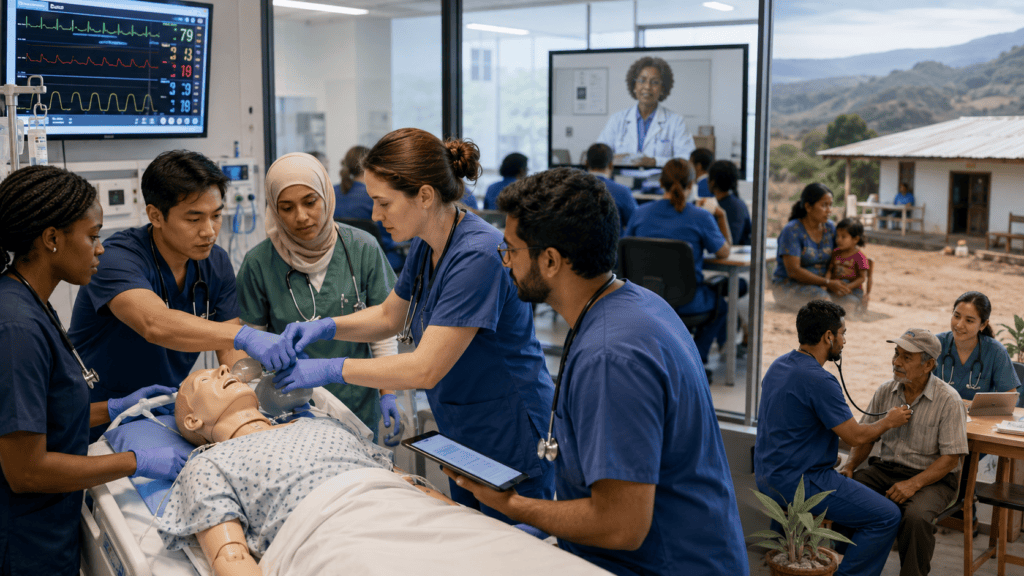
Health equity is often discussed through the language of access. People need clinics within reach, appointments they can afford, insurance systems they can understand, and transportation that does not turn a basic visit into a full-day problem. These are all real barriers. The World Health Organization describes health equity as the absence of unfair, avoidable, or remediable differences between groups of people. But one part of the conversation receives less attention: the quality and consistency of clinical training.
A patient in a large academic hospital may be treated by a team that regularly sees complex cases, trains with updated equipment, and has access to specialist support. A patient in a rural clinic or under-resourced community hospital may meet a team that is skilled and committed, but has fewer chances to practice rare emergencies, uncommon complications, or specialized procedures. That difference matters. Health equity is not only about whether a patient enters the healthcare system. It is also about what kind of care they receive once they are inside it.
Health Equity Is Also a Training Problem
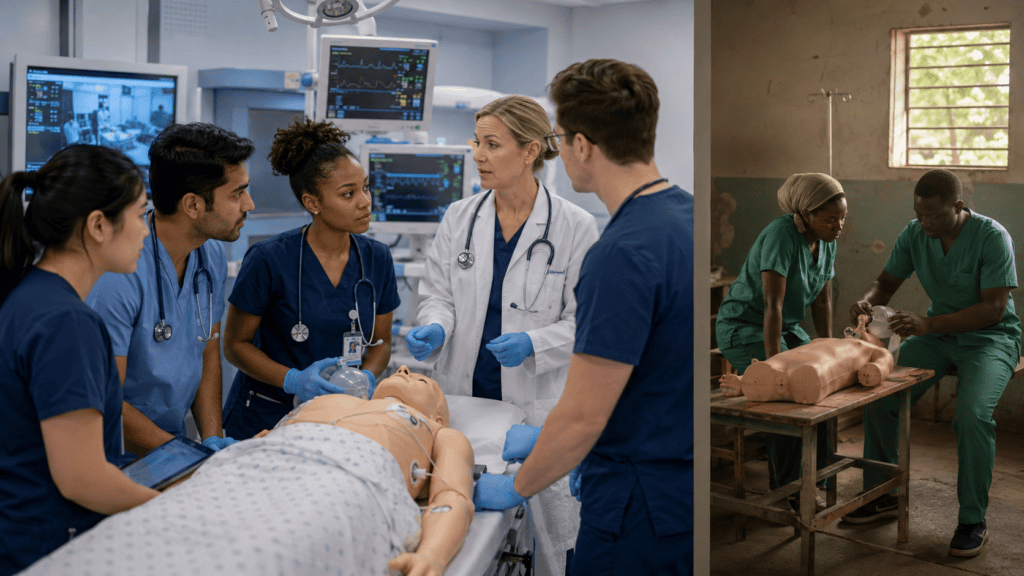
Clinical training does not happen evenly across all healthcare settings. Some institutions have large simulation centers, frequent team-based drills, and access to advanced educational technology. Others rely heavily on bedside learning, limited case exposure, and whatever resources are available locally. The result is not always a difference in motivation or intelligence. Often, it is a difference in opportunity.
This is where simulation-based training can play an important role. It gives medical students, nurses, residents, emergency teams, and other healthcare workers a way to practice clinical judgment before the stakes involve a real patient. A difficult airway, postpartum hemorrhage, pediatric seizure, trauma response, or sudden cardiac event can be recreated in a controlled environment. The same scenario can be repeated until the team improves not only the technical steps, but also communication, timing, and role clarity.
What Training Inequality Can Look Like
Training gaps are not always obvious from the outside. They may appear in small practical differences:
- one hospital team regularly rehearses emergency scenarios, while another rarely has time for drills;
- one medical program has access to simulation labs, while another depends mostly on chance clinical exposure;
- one group of learners practices rare complications repeatedly, while another may only read about them;
- one clinical team receives structured feedback after a scenario, while another learns mainly during real pressure.
These differences can affect confidence, speed, communication, and decision-making. In health equity work, consistency matters. If training depends only on who happens to be present when a rare case occurs, learning becomes uneven. Simulation helps reduce that randomness. It gives educators a way to bring important cases into the room even when those cases are not appearing in the hospital that week.
Real Patients Should Not Be the First Practice Case
Medicine has always involved learning through experience. That will not change. Real patients, real symptoms, and real decisions remain at the center of clinical education. But there is a difference between learning from patients and using patients as the first opportunity to practice a high-risk skill.
A student should not meet a critical emergency for the first time during an actual crisis. A new nurse should not have to learn team communication only when a patient is deteriorating. A resident should not encounter a complex procedure without first having a safe place to make mistakes, ask questions, and repeat the steps.
This is one reason organizations such as AHRQ discuss simulation training as part of patient safety education. Simulation gives learners a protected space to slow down situations that, in real life, move too quickly. It allows instructors to pause, review, correct, and rebuild confidence without putting a patient at risk.
A Safer Place to Make Early Mistakes
Mistakes are part of learning, but the setting matters. In a simulation room, a missed step becomes a teaching moment. In a real emergency, the same missed step can affect a patient. This does not mean simulation replaces clinical experience. It means learners can enter clinical settings better prepared, with a clearer sense of what to do, what to ask, and how to work with the team around them.
This matters for equity because patients in underserved areas should not receive care from teams that had fewer chances to prepare. Simulation cannot remove every structural barrier in healthcare, but it can help make preparation less dependent on geography, funding level, or case volume.
Simulation Makes Rare Cases Repeatable
One of the biggest limits of traditional clinical training is that rare events are rare. A learner may finish a rotation without seeing a neonatal emergency, a severe allergic reaction, a complicated delivery, or a difficult airway. Another learner in a different hospital may see several. That difference can shape confidence and readiness for years.
Simulation changes the pattern. Rare cases can be scheduled, repeated, and adapted. A scenario can begin simply, then become more complex. A team can practice the first five minutes of an emergency several times, because those first minutes often set the tone for everything that follows. Instructors can test not only whether a learner knows the correct action, but whether the team can act clearly under pressure.
This repeatability is especially useful for community hospitals and smaller clinical programs. These settings may not see the same volume of specialized cases as major medical centers, yet they still need to be ready when emergencies arrive. A rural emergency department may not handle pediatric trauma every week, but when it does, the team must respond immediately. A small maternity unit may not see a severe complication often, but preparation still matters.
Better Training for Underserved Regions
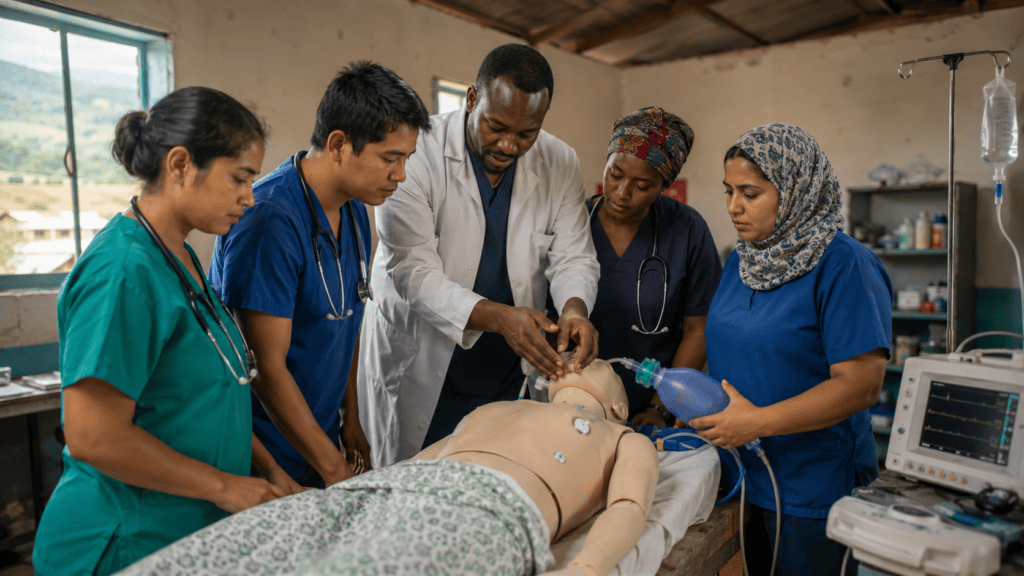
Health disparities often appear in places where resources are stretched. Smaller hospitals may have fewer specialists. Rural clinics may have limited equipment. Community health centers may serve large numbers of patients with complex social and medical needs. In these environments, training has to be practical, repeatable, and adaptable.
Simulation-based education can support that goal in several ways:
- It can standardize essential skills.
A program can define the scenarios that every learner or team must complete, regardless of where they train. - It can strengthen team communication.
In many emergencies, the issue is not only whether one person knows the answer, but whether the whole team can coordinate. - It can prepare teams for low-frequency, high-risk events.
These are the cases that may not appear often in daily practice, but still require immediate and confident action. - It can make feedback more structured.
After a simulation, educators can review decisions, timing, communication, and missed signals in a way that is difficult during real patient care. - It can include social and communication barriers.
A scenario can involve language differences, health literacy challenges, delayed care, cost concerns, or distrust of the healthcare system.
Beyond Technical Skills
Health equity is not only technical. It includes how clinicians speak with patients, how they explain risk, how they listen to concerns, and how they recognize barriers outside the exam room. Simulation can include these realities too. A scenario can involve a patient who does not understand discharge instructions, a family member who is anxious, or a person who delayed care because transportation was difficult.
These details make training more human. They also remind clinicians that equitable care is not only about making the correct diagnosis. It is also about meeting patients in the reality they live in.
Technology Should Serve Practical Equity
Not every technology improves healthcare equity. Some tools make systems more expensive, harder to access, or more dependent on large institutions. The best educational technology does the opposite: it makes important practice easier to repeat, easier to share, and easier to adapt to different settings.
Modern medical simulation tools, including high-fidelity patient simulators, ultrasound training systems, and anatomy solutions from MedVision, can help medical educators create practical scenarios that prepare teams for real clinical decisions. The value is not in the equipment alone. The value is in how that equipment is used: to build confidence, reduce avoidable variation in training, and give more learners access to realistic practice before they meet patients in high-pressure situations.
For health equity, this practical focus is essential. A simulator is not a solution to poverty, insurance gaps, transportation barriers, or workforce shortages. But it can support a more consistent training environment. It can help a smaller program teach the same emergency response steps as a larger institution. It can help learners practice patient communication before a difficult conversation happens in real life. It can help educators identify weak points in a team’s workflow before those weak points affect care.
A More Consistent Standard of Care
Simulation-based training will not solve every problem in healthcare. It cannot replace policy reform, community investment, affordable care, or enough trained professionals in the right places. But it can address one important part of the equity puzzle: preparation.
Patients should not receive different levels of readiness simply because one hospital sees more cases than another, or because one training program has more opportunities than another. When clinical teams can practice rare events, review mistakes safely, and repeat important scenarios, the quality of preparation becomes more consistent.
The Equity Question for Educators
A useful question for medical educators is simple: has every learner had a fair chance to practice the skills that patients may one day depend on?
If the answer is no, then training itself becomes part of the equity conversation. Health equity begins long before a patient enters an exam room. It begins in classrooms, labs, simulation centers, staff training, and team drills.
Simulation-based training is not only a teaching method. Used well, it is a way to make clinical readiness more fair, more repeatable, and more connected to the needs of real communities.